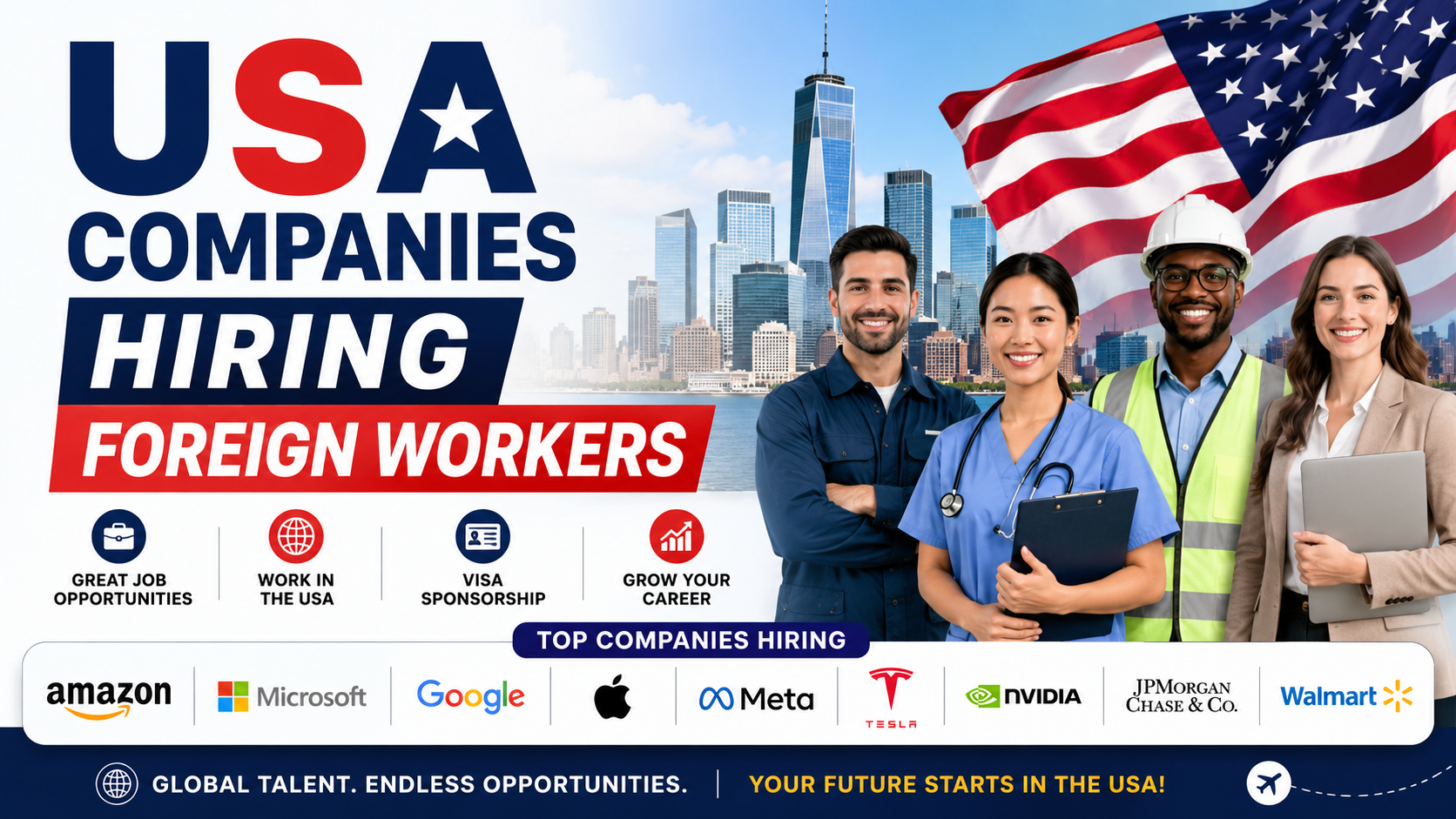
Why Foreign Workers Remain Important to the U.S. Job Market
Foreign workers continue to play a major role in the American labor market because many U.S. companies need specialized talent, multilingual professionals, technical experts, healthcare staff, and globally experienced employees who can fill critical gaps in the workforce. In sectors such as software engineering, cloud computing, artificial intelligence, semiconductor design, healthcare, finance, and consulting, companies often struggle to find enough qualified candidates quickly within the domestic labor pool. As a result, employers turn to foreign workers not simply as a backup option, but as a strategic part of growth, innovation, and long-term competitiveness. In many cases, businesses are not just hiring people to fill empty seats; they are hiring professionals with specific expertise in machine learning, cybersecurity, enterprise systems, medical care, analytics, research, and international operations. This is why foreign hiring in the United States is closely tied to industries where talent shortages, advanced technical requirements, and global business expansion are strongest.
The Main Visa Paths Used by U.S. Employers to Hire International Talent
When people talk about U.S. companies hiring foreign workers, they often focus only on the H-1B visa, but in reality, American employers use several employment-based immigration pathways depending on the job, the worker’s nationality, and the company’s needs. The H-1B visa is one of the best-known options for specialty occupations such as engineering, IT, data science, finance, and research. However, companies also use L-1 visas for intra-company transfers, O-1 visas for individuals with extraordinary ability, TN visas for eligible Canadian and Mexican professionals under trade agreements, and H-2B or H-2A visas for certain seasonal labor needs. Some employers also sponsor workers directly for employment-based green cards after hiring them. Understanding this broader visa landscape is important because a company may be open to international talent even if it is not using the exact same visa category for every role. The phrase “hires foreign workers” therefore covers a much wider hiring system than many applicants initially assume.
Why Large U.S. Technology Companies Lead Foreign Worker Hiring
Large American technology companies are among the most visible employers of foreign workers because their business models depend heavily on highly specialized knowledge, fast product development, and constant innovation. Firms working in cloud infrastructure, AI systems, enterprise software, semiconductors, cybersecurity, and digital advertising often compete globally for the same limited pool of engineers, researchers, and product specialists. Because of this, they actively recruit talent from around the world and maintain internal immigration processes that are more mature than those of smaller companies. Tech companies are also more likely to have legal teams, mobility specialists, and recruiting systems that can handle sponsorship paperwork, compliance, and relocation support. This makes them attractive to international candidates who want employers with experience in hiring foreign nationals. It also explains why technology firms appear so frequently in sponsorship rankings and immigration-related employment discussions.
Amazon as a Major Employer of Foreign Professionals in the United States
Amazon is consistently one of the most recognized U.S. employers of foreign workers, especially in software engineering, cloud services, data science, operations research, product management, and logistics technology. The company’s scale is one reason it appears so often in sponsorship discussions. Amazon is not a single narrow employer with one type of job; it is a vast business ecosystem that includes e-commerce, advertising, AI tools, warehouse systems, supply chain technology, streaming, devices, and cloud computing through AWS. Because of that breadth, it recruits talent across multiple technical and business functions. For international applicants, Amazon is often seen as a realistic target because it hires at different seniority levels, including experienced engineers, analysts, operations specialists, and in some cases new graduates. Its history of visa-related filings and broad hiring footprint make it one of the most important names in any conversation about U.S. companies employing foreign professionals.
Microsoft’s Longstanding Role in Hiring International Talent
Microsoft has long been one of the most international-facing employers in the American corporate world, particularly for software engineers, cloud architects, security specialists, AI researchers, technical program managers, and enterprise consultants. The company’s business spans operating systems, developer tools, Azure cloud services, enterprise software, gaming, cybersecurity, and AI products, all of which require highly skilled professionals. Because Microsoft serves customers around the world and builds products at massive scale, it often values candidates with advanced technical backgrounds, research ability, and global experience. For foreign workers, Microsoft is attractive not only because it has sponsored many professionals historically, but also because it offers a broad range of roles beyond pure software engineering, including sales engineering, product strategy, technical support, and business operations. It is one of the clearest examples of a U.S. employer whose global reach naturally supports international hiring.
Google and Meta as Key Employers for High-Skilled Foreign Workers
Google and Meta are frequently associated with foreign hiring because both companies recruit heavily for advanced technical and product-focused roles. These organizations typically look for talent in software engineering, machine learning, infrastructure, data science, distributed systems, privacy, security, and product design. They are also known for hiring people with strong academic credentials, deep coding ability, research experience, or highly specialized product expertise. International professionals often target these companies because they have a track record of hiring globally and because the work itself sits at the center of major technology trends such as AI, large-scale data platforms, mobile ecosystems, and digital advertising systems. However, these companies are also extremely competitive, and simply being open to foreign workers does not mean they hire casually. Candidates usually need exceptional technical strength, interview preparation, and a strong match for the role.
Consulting and IT Services Firms as Major Sponsors of Foreign Workers
A large portion of foreign worker hiring in the United States comes not only from consumer-facing tech giants, but also from consulting and IT services firms that deliver technology, analytics, business transformation, and enterprise solutions to corporate clients. Companies such as Cognizant, Infosys, Tata Consultancy Services, Accenture, Deloitte, and Ernst & Young (EY) frequently appear in sponsorship-related discussions because their businesses depend on supplying skilled professionals to large enterprise projects. These firms often hire software engineers, SAP consultants, data analysts, cloud specialists, cybersecurity consultants, auditors, and business transformation professionals. For foreign workers, consulting firms can be significant because they may hire across multiple client engagements and functional areas rather than for a single product line. At the same time, applicants should understand the demands of consulting work, which may involve project-based assignments, frequent collaboration, and in some roles travel or hybrid expectations.
Finance and Banking Employers Also Hire Foreign Professionals
Many people associate foreign worker hiring only with Silicon Valley, but major U.S. financial institutions and banks also hire international talent, especially in quantitative finance, software engineering, cybersecurity, risk management, analytics, compliance technology, and operations. Companies such as JPMorgan Chase, Goldman Sachs, and other large financial employers often need specialists who can build internal trading systems, manage large data environments, strengthen digital security, support global financial products, and analyze complex risk models. Banking has become deeply technology-driven, and many roles that exist inside major financial institutions now look very similar to jobs in the tech sector. This means foreign workers with strong engineering, analytics, and mathematics backgrounds can find real opportunities in finance if they understand the industry’s expectations. For applicants willing to look beyond the most famous tech companies, banking and financial services can be a meaningful part of the foreign hiring landscape.
Semiconductor, Hardware, and AI Infrastructure Companies Are Increasingly Important
As artificial intelligence, chip design, and advanced computing become more central to the global economy, hardware and semiconductor companies have become especially important employers of foreign professionals in the United States. Firms such as NVIDIA, Intel, AMD, and Oracle need engineers and researchers in areas like chip architecture, systems engineering, AI frameworks, hardware-software integration, distributed computing, and enterprise infrastructure. These companies often seek candidates with advanced STEM backgrounds, hands-on technical depth, and experience solving highly complex engineering problems. For foreign workers with expertise in electrical engineering, computer architecture, machine learning, or systems design, this category of employers can be just as important as the better-known consumer tech brands. It also reflects a broader truth: foreign hiring in the U.S. is not just about apps and websites; it is also about the deep technical infrastructure behind modern computing.
Healthcare, Research, and University-Linked Employers Also Sponsor International Talent
Although technology and consulting receive most of the attention, the U.S. healthcare and research ecosystem is another major destination for foreign workers. Hospitals, university medical centers, research institutions, biotech firms, and academic employers often hire international physicians, researchers, postdoctoral fellows, pharmacists, scientists, data specialists, and healthcare professionals in shortage areas. In many cases, these employers use different immigration pathways from those commonly seen in big tech, and the hiring process may be tied to licensure, residency training, fellowships, or research grants. This is important because a person looking for U.S. sponsorship should not assume the opportunity landscape begins and ends with software companies. In reality, medical institutions, public health systems, pharmaceutical employers, and research organizations can offer strong long-term paths for foreign professionals, especially those with advanced degrees, clinical credentials, or scientific specialization.
How to Identify the Right U.S. Companies and Improve Your Chances of Being Hired
Not Every Company That Sponsors Foreign Workers Is a Good Target for Every Applicant
One of the biggest mistakes international job seekers make is assuming that any company with a history of sponsoring foreign workers is automatically a good place to apply. In reality, sponsorship history is only one part of the picture. A company may have sponsored many foreign workers in the past but still hire very selectively, prefer experienced professionals, or focus almost entirely on niche roles that do not match your background. Some employers sponsor heavily in consulting, some in engineering, some in healthcare, and some in research-based positions. That is why applicants should not build their strategy around a single list of famous companies. Instead, they should study whether the employer actually hires for their profession, experience level, and skill set. A strong application strategy is based on fit, not just on brand recognition or raw sponsorship numbers.
How to Research Whether a U.S. Company Is Realistically Open to International Candidates
If you want to know whether a U.S. employer is a realistic target, you need to look beyond generic job titles and examine the company’s hiring behavior in detail. Start by reviewing the employer’s careers page, job descriptions, location requirements, and any wording related to work authorization. Some postings clearly say whether the company will sponsor visas now, in the future, or not at all. Others may not mention sponsorship but still show clues, such as global mobility language, relocation support, or a pattern of hiring in specialized technical areas where international recruitment is common. It is also useful to look at employee profiles on LinkedIn, public immigration data, and the company’s overall scale and industry. A business that operates globally, hires advanced technical talent, and has a history of employing international professionals is often a stronger target than a smaller company with no visible immigration experience. Smart research helps you avoid wasting time on employers that are unlikely to move forward with a foreign applicant.
Why Job Description Language Matters More Than Many Applicants Realize
Job descriptions often contain subtle but important signals about whether an employer is likely to consider foreign workers. Some postings explicitly state “must be authorized to work in the United States without sponsorship,” which is a direct warning that the employer is not currently open to visa sponsorship for that role. Others may say “visa sponsorship available for qualified candidates,” “open to global talent,” or “immigration support may be provided depending on the position.” Even when the wording is less direct, the structure of the role can offer clues. Highly specialized positions in cloud engineering, machine learning, chip design, quantitative research, or advanced healthcare are often more likely to justify sponsorship than general administrative jobs. Reading job descriptions carefully allows candidates to separate serious opportunities from listings that are unlikely to lead anywhere. In international job searching, this kind of close reading is not optional; it is one of the most practical ways to improve efficiency and reduce disappointment.
The Importance of Choosing Roles That Match Sponsorship Reality
Foreign workers often improve their chances by targeting roles where sponsorship makes business sense for the employer. Companies are far more likely to invest time, money, and legal effort into sponsorship when the role is difficult to fill, highly technical, revenue-relevant, or strategically important. This is why positions in software engineering, data engineering, AI, cloud systems, semiconductor design, consulting, advanced analytics, nursing shortages, medical specialties, and research often remain stronger targets than very general roles with large domestic applicant pools. That does not mean other roles are impossible, but it does mean candidates should be realistic. If a company can easily fill a role with hundreds of local applicants, it has less incentive to sponsor. By contrast, if the role demands uncommon expertise or a difficult combination of skills, the company may be more willing to consider a foreign worker. Aligning your applications with sponsorship reality is one of the smartest ways to build a serious U.S. job strategy.
Why Resume Positioning Is Critical for International Applicants
For foreign workers applying to U.S. companies, a resume should not just summarize experience; it should present the candidate as a low-risk, high-value professional whose skills are clearly worth the effort of sponsorship. Employers often review international applications with extra caution because sponsorship adds cost, paperwork, and uncertainty. That means your resume must immediately communicate relevance, results, and specialization. Instead of using vague descriptions, candidates should show measurable outcomes, technical depth, business impact, and evidence of problem-solving in real environments. If you have worked with international teams, handled large-scale systems, led process improvements, built products, or supported clients across markets, those achievements should be visible. The goal is to make the employer feel that hiring you is not an act of generosity but a rational business decision. A strong resume does not hide the fact that you are an international candidate; it makes your value so clear that the sponsorship question becomes easier to justify.
Why Networking Can Matter as Much as the Application Itself
Many international candidates focus almost entirely on online applications, but networking can be just as important, especially when competing for sponsorship. A referral or warm introduction does not guarantee a job, but it can dramatically increase the chances that your application will actually be seen by the right people. In large U.S. companies, recruiters and hiring managers receive huge volumes of applications, and international candidates can easily disappear in that crowd. Networking helps solve that problem by giving your profile context and visibility. This does not mean sending random messages asking strangers for sponsorship. It means building real professional connections, joining industry communities, participating in technical discussions, engaging with alumni networks, and respectfully learning from people already working in the roles you want. Over time, these relationships can lead to referrals, advice on target teams, insight into which departments are open to international talent, and a much more informed application strategy.
Why International Applicants Should Track Company Immigration Patterns, Not Just Headlines
A company may be famous for sponsoring foreign workers, but headlines alone do not tell you what is happening right now. Hiring demand changes with business cycles, immigration policy, layoffs, budget cuts, and shifts in corporate priorities. Some firms that sponsored heavily in one year may slow down in the next, while others may expand in areas like AI, chips, healthcare, or cybersecurity and become more open to international hiring. This is why serious applicants should monitor patterns rather than relying on old lists. Look at current job openings, recent growth areas, public immigration filings, executive comments about talent needs, and the company’s overall business direction. If a firm is actively expanding in a field where your expertise is relevant, that matters far more than whether it sponsored a large number of workers three years ago. The best targets are not simply “big sponsors”; they are employers whose present business needs line up with your skills right now.
Why Mid-Sized and Lesser-Known U.S. Employers Should Not Be Ignored
Many international candidates apply only to the most famous American companies, but that strategy can be limiting. Large brands like Amazon, Microsoft, Google, and Meta receive enormous numbers of applications, making them extremely competitive even for strong candidates. Meanwhile, mid-sized firms, specialized software companies, AI startups, healthcare systems, semiconductor suppliers, biotech employers, and enterprise consulting firms may offer excellent opportunities with less competition. Some of these companies have real sponsorship experience but attract far less public attention. Others may not sponsor at the same volume as a tech giant, but they may still be very willing to hire an exceptional candidate for a role they struggle to fill locally. Expanding your target list beyond household names can improve your odds substantially. The smartest international applicants often build a mixed strategy: they apply to major sponsors, but they also identify smaller high-fit employers where their chances of standing out are stronger.
How Interview Performance Can Influence Sponsorship Decisions
When a company is considering a foreign candidate, the interview often carries extra weight because the employer is evaluating not just skill, but whether the person is worth the additional effort of immigration sponsorship. That means interview performance should communicate much more than technical competence. It should show maturity, clarity, professionalism, and the ability to deliver results in a U.S. workplace. Candidates should be ready to explain their experience in a structured way, speak confidently about projects, demonstrate problem-solving ability, and show that they understand the business context of the role. They should also answer work-authorization questions honestly and clearly without creating confusion. If the employer feels uncertain about your communication, your level of readiness, or your fit for the role, sponsorship becomes harder to justify. On the other hand, a strong interview can change the entire conversation by making the employer feel that hiring you is worth the process.
Why Patience and Strategy Matter More Than Sending Hundreds of Random Applications
International job seekers often feel pressure to apply everywhere at once, but a scattered approach usually produces poor results. U.S. companies that hire foreign workers are not just looking for available people; they are looking for candidates who fit their role, their timing, and their business needs. Sending hundreds of low-quality applications to unrelated jobs rarely works because it creates effort without strategy. A better approach is to identify target industries, choose companies with realistic sponsorship potential, tailor your resume to the role, build relationships where possible, and focus on positions where your skills genuinely match the employer’s needs. This process is slower, but it is far more effective. For foreign workers, success often comes from persistence combined with precision, not desperation. The strongest outcomes usually go to candidates who treat the U.S. job search as a long-term campaign rather than a lottery.
Challenges, Realities, and Long-Term Career Strategy for Foreign Workers Targeting U.S. Employers
Sponsorship Does Not Mean Easy Hiring
One of the most important realities foreign workers must understand is that a company being “open to sponsorship” does not mean it will hire international candidates easily or frequently. Sponsorship only means the employer has the ability or willingness to consider it under the right circumstances. The actual hiring decision still depends on competition, budget, timing, immigration risk, and the candidate’s overall strength. A company may sponsor only a small percentage of applicants, reserve sponsorship for specific departments, or limit it to experienced professionals. This is why many international job seekers become frustrated after targeting well-known sponsors but receiving no progress. The missing piece is often the assumption that sponsorship equals access. In reality, sponsorship is just one door that may open if the candidate’s value is strong enough and the role is important enough to justify it.
Entry-Level Candidates Face a Different Market Than Experienced Professionals
Not all foreign workers are competing in the same labor market. Entry-level applicants, especially recent graduates, often face a more difficult path because many U.S. companies prefer to reserve sponsorship for roles that require specialized experience or advanced skills. When an employer can choose from a large pool of local junior candidates, the incentive to sponsor a new graduate is usually lower. By contrast, experienced professionals with proven results in engineering, AI, consulting, healthcare, finance, or research may be easier to justify because their skills are harder to replace quickly. This does not mean entry-level sponsorship never happens; it absolutely does. However, early-career candidates need a sharper strategy, stronger internships or project work, and a more realistic target list. They may need to prioritize employers known to hire at scale, graduate talent programs that accept international applicants, or roles where technical skill clearly outweighs the costs of sponsorship.
Immigration Policy Changes Can Affect Hiring Even When Your Skills Are Strong
Foreign worker hiring in the United States does not depend only on talent and demand; it is also influenced by immigration rules, processing delays, legal uncertainty, filing costs, and changes in government policy. A company that is enthusiastic about hiring international talent may still become cautious if visa fees rise, lottery rules change, adjudication becomes slower, or legal risk increases. This means foreign workers need to understand that rejection is not always a verdict on their ability. Sometimes the employer may genuinely like the candidate but decide the immigration process is too uncertain or expensive at that moment. This reality can be frustrating, but it is part of the system. Serious applicants should stay informed about immigration developments while also focusing on what they can control: skills, positioning, employer targeting, and interview performance. Knowing the policy environment does not replace job preparation, but it helps explain why the market can shift so quickly.
The Strongest Candidates Usually Make Sponsorship Feel Commercially Worthwhile
Employers are far more willing to sponsor foreign workers when the business case is obvious. That business case becomes strongest when a candidate brings scarce technical ability, strong execution, domain expertise, leadership potential, or a combination of skills that would be difficult to replace locally. In other words, the goal is not simply to be “qualified”; it is to be valuable enough that the company sees sponsorship as an investment rather than a burden. This is why candidates who stand out often have deep expertise in a narrow area, a record of measurable results, advanced education in a relevant field, or experience with technologies and systems that are directly tied to revenue, product growth, or strategic priorities. The more clearly you can show that your work solves an expensive problem for the employer, the easier it becomes for that employer to justify the immigration process.
Career Planning Should Focus on Skill Depth, Not Just Geography
Many international candidates become so focused on “getting to the U.S.” that they forget the deeper issue: what makes them competitive in the first place. Geography matters, but skill depth matters more. A weak candidate in the right location is still weak in the eyes of a demanding employer, while a highly valuable candidate often creates more options across countries and companies. This is why long-term planning should focus on building serious expertise in fields where U.S. employers have strong and continuing demand. That may include software engineering, cloud systems, machine learning, chip design, product analytics, enterprise consulting, nursing, medical specialties, biotech research, or other high-skill areas. The better your skills become, the more flexible your path becomes. A U.S. job search should be built on professional strength first and immigration ambition second, not the other way around.
International Candidates Need to Learn the Business Language of Their Field
Technical ability alone is often not enough to win roles at U.S. companies. Employers also want people who can explain their work in business terms, collaborate across teams, and show awareness of outcomes rather than just tasks. For foreign workers, this is especially important because communication gaps can make employers hesitate. A software engineer should be able to explain how their work improved reliability, reduced cost, accelerated delivery, or increased customer value. A data analyst should be able to connect dashboards and models to business decisions. A healthcare professional should be able to discuss patient outcomes, workflow, compliance, and care quality. When candidates speak only in narrow technical language without explaining impact, they weaken their own case. Learning the business language of your field makes you more persuasive in interviews, stronger in resumes, and easier for U.S. employers to imagine as part of a real working team.
Building a U.S.-Ready Professional Profile Often Starts Before the Job Search
The best time to prepare for U.S. employers is not the week you start applying; it is months or years earlier. A strong profile is usually built gradually through projects, internships, certifications, research, portfolio work, publications, client results, leadership experiences, and targeted skill development. International applicants who wait until the last minute often discover that they are missing the proof points needed to compete for sponsorship-worthy roles. For example, a cloud engineer may need hands-on AWS or Azure work, a machine learning candidate may need deployed projects or research depth, and a consultant may need evidence of structured problem-solving and client impact. The stronger your evidence of competence, the less your application depends on hope. U.S. companies hiring foreign workers are still hiring on merit; they simply apply that merit test in a market where the bar can be high. Preparation well before the application stage gives you a real advantage.
Long-Term Success Depends on Choosing Employers That Fit Your Career, Not Just Your Visa Need
Some international applicants become so focused on finding any employer willing to sponsor that they overlook whether the company is actually good for their long-term growth. That can be a costly mistake. A job may solve an immigration problem in the short term but create career stagnation if the work is low quality, the learning is weak, or the employer’s culture is unstable. Whenever possible, foreign workers should evaluate sponsorship employers the same way any strong professional would: by looking at the quality of the role, the manager, the learning opportunity, compensation, advancement potential, and business health of the company. Sponsorship matters, but it should not be the only filter. A good employer can help you build skills, credibility, and future mobility, while a poor fit can trap you in a narrow role with little career value. The best outcome is not just getting sponsored; it is getting sponsored by a company that actually moves your career forward.
Rejection Is Normal, and It Should Be Interpreted Carefully
Foreign workers often take rejection personally, especially after spending weeks tailoring applications and preparing for interviews. But in the U.S. market, rejection can happen for many reasons that have little to do with your worth as a professional. A company may freeze hiring, choose an internal candidate, decide against sponsorship for budget reasons, prefer someone with niche domain experience, or simply receive a stronger applicant from within its own network. If you interpret every rejection as proof that you are not good enough, you will damage your own momentum. A better approach is to review patterns objectively. Are you getting interviews but not passing them? Then the issue may be interview performance. Are you applying widely but hearing nothing back? Then your targeting or resume positioning may need work. Strategic self-review is far more useful than emotional self-blame. In international hiring, resilience is not optional; it is part of the process.
The Most Effective Strategy Is to Treat the U.S. Job Search as a Professional Campaign
Foreign workers who succeed with U.S. companies usually approach the process with structure, patience, and discipline. They do not rely only on luck, viral lists, or last-minute applications. Instead, they identify target industries, study employers, refine their resume, build relevant skills, network intelligently, prepare for interviews, and keep adjusting based on feedback and results. They also understand that the process may take time and that the strongest opportunities often come after repeated effort rather than a single breakthrough. Treating the U.S. job search as a professional campaign changes your mindset completely. You stop asking, “Which company will sponsor me quickly?” and start asking, “How do I become the kind of candidate that strong employers are willing to sponsor?” That shift is powerful because it moves your focus away from desperation and toward strategy, which is exactly where long-term success begins.