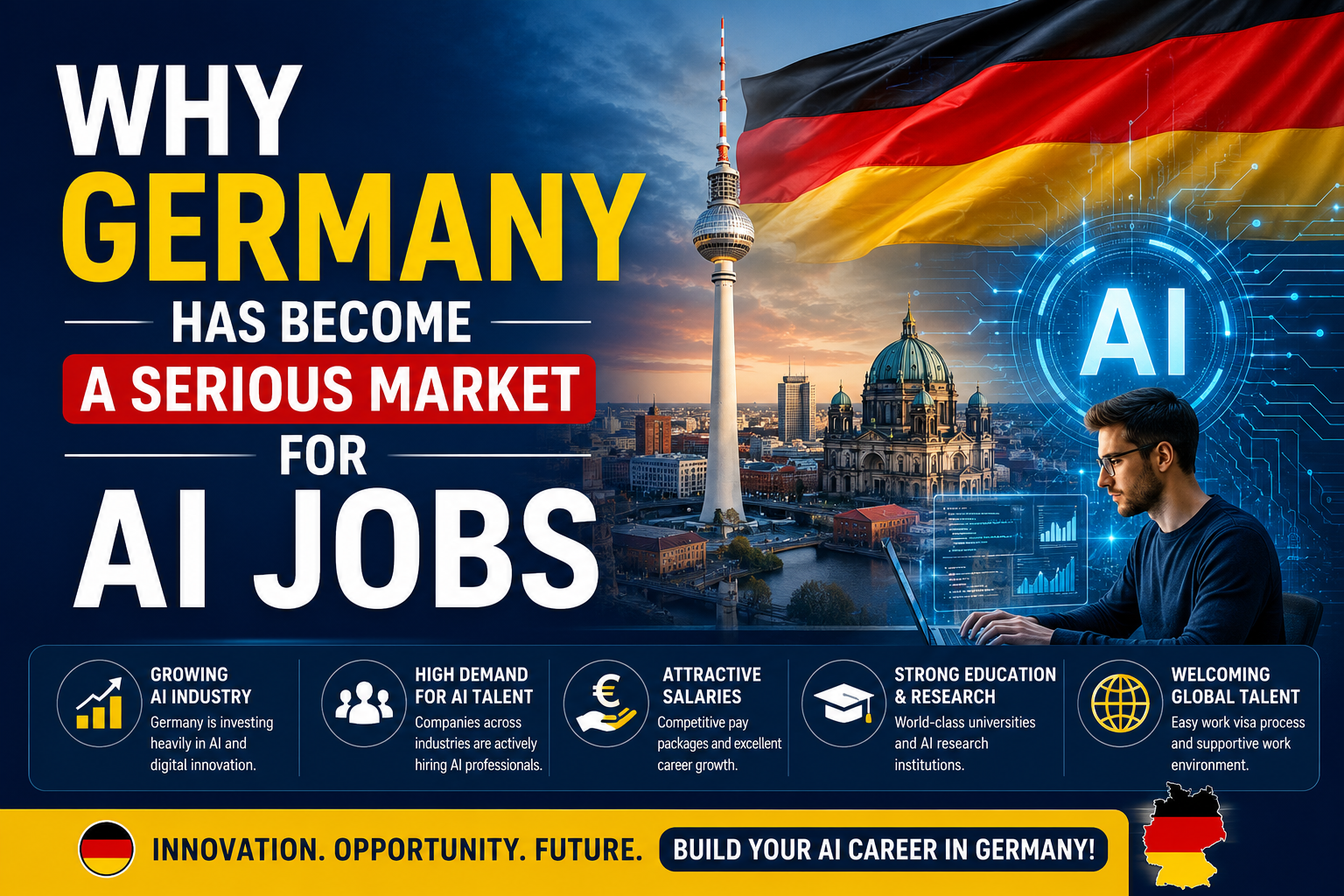
Germany Is No Longer Just an Automotive and Manufacturing Economy
Germany is still strongly associated with cars, machinery, and industrial engineering, but its employment market has changed in a major way over the last few years. Artificial intelligence is now being used across automotive software, robotics, logistics, healthcare, finance, cybersecurity, industrial automation, e-commerce, and enterprise software. This has created demand for people who can build, train, deploy, monitor, and improve AI systems rather than simply talk about them in theory. In practical terms, this means Germany is no longer offering AI work only inside a few research labs or famous global companies. AI roles are now spread across startups, mid-sized software firms, large enterprises, consulting companies, industrial technology businesses, and research-driven organizations. For job seekers, that matters because it broadens the market. Instead of depending on a tiny number of employers, candidates can now target multiple industries where AI is becoming commercially useful, especially where machine learning can improve efficiency, prediction, automation, quality control, or customer experience.
AI Hiring in Germany Is Being Driven by Business Use Cases, Not Just Hype
One of the most important things to understand about AI jobs in Germany is that companies are increasingly hiring because they want business outcomes, not because they want to appear fashionable. Employers are investing in AI to reduce operational costs, improve forecasting, automate document-heavy workflows, optimize supply chains, build smarter products, detect fraud, strengthen industrial quality control, and create new software features. This matters because it changes what companies expect from candidates. Employers are often less interested in abstract AI enthusiasm and more interested in whether a candidate can turn models into working systems that solve measurable problems. A person who understands model deployment, data pipelines, evaluation, monitoring, compliance, and business constraints is usually more valuable than someone who only knows how to train a notebook model. In Germany especially, where engineering quality and reliability are taken seriously, the ability to connect AI to real operational impact can make a major difference in hiring outcomes.
The German AI Job Market Rewards Practical Technical Depth
There is a common mistake many candidates make when approaching AI jobs in Germany: they assume that “AI” is one broad category and that learning a few popular buzzwords will be enough. In reality, the market rewards practical depth. Companies want professionals who can write production-quality Python, handle data engineering basics, understand model training and evaluation, work with cloud tools, and communicate clearly with product, business, or operations teams. Employers are often looking for a combination of software engineering discipline and machine learning understanding rather than purely academic experimentation. This is one reason why machine learning engineers, AI engineers, and MLOps-capable professionals are often attractive hires. They are closer to production and business delivery. The German market, particularly in enterprise and industrial settings, tends to value reliability, structure, documentation, and implementation quality. As a result, candidates who can show complete project ownership—from data preparation to deployment and monitoring—often stand out more than those with fragmented or purely theoretical experience.
AI Job Titles in Germany Do Not All Mean the Same Thing
A major source of confusion for job seekers is the variety of titles used across the German market. A role called “AI Engineer” at one company may look very similar to “Machine Learning Engineer” at another, while a “Data Scientist” position might range from dashboard-heavy analytics to deep model development. In some cases, “Applied Scientist,” “AI Developer,” “Computer Vision Engineer,” “NLP Engineer,” “MLOps Engineer,” or “Data Engineer with ML focus” may overlap substantially. This matters because candidates should not apply based on titles alone. They need to read job descriptions carefully to understand whether the role is research-heavy, product-focused, infrastructure-focused, analytics-oriented, or primarily software engineering with some AI integration. Germany’s AI market contains all of these variations. Someone who ignores that reality may end up applying to the wrong roles and then assume the market is weak, when the real issue is mismatch. Strong job searching in Germany depends on understanding the actual work behind the title, not just the title itself.
The Strongest AI Hubs in Germany Offer Different Kinds of Opportunity
Germany is not a single uniform AI market. Cities and regions differ in the type of employers they attract, the salaries they pay, and the kind of AI work they emphasize. Berlin is often associated with startups, product companies, SaaS, consumer technology, experimentation, and scaleups. Munich tends to be strong in deep tech, enterprise software, automotive technology, semiconductors, AI infrastructure, and higher-paying engineering roles. Hamburg, Frankfurt, Stuttgart, Cologne, and parts of North Rhine-Westphalia also offer opportunities, especially where logistics, finance, manufacturing, consulting, and industrial technology are strong. This means candidates should not think only in terms of “Germany” as a single market. They should think in terms of local ecosystems. A candidate interested in computer vision for autonomous systems may target very different employers from someone interested in AI product analytics or LLM tooling. The more clearly you understand which city or region aligns with your specialization, the better your applications, salary expectations, and networking strategy will become.
Salaries in Germany Depend Heavily on Role Type, Seniority, and Production Value
AI salaries in Germany can look confusing because published numbers vary widely depending on source, role label, and whether the role is closer to research, software engineering, or production machine learning. Broadly speaking, 2026 salary guides place junior AI engineers in roughly the €55,000–€75,000 range, mid-level professionals around €70,000–€105,000, and senior AI engineers around €90,000–€140,000+, with especially specialized roles in LLM systems, AI infrastructure, and top-tier markets sometimes stretching higher. StepStone’s Germany data for Machine Learning Engineers is more conservative, with a median around €57,800 and an upper range around €66,600, which shows how title definitions and employer mix can change the picture. The key lesson is that salary is not determined by the word “AI” alone. It is strongly influenced by whether the role includes deployment, infrastructure, business-critical ownership, industry specialization, and experience level. A production-oriented AI engineer who owns pipelines and model delivery may command far more than a more general analyst-style role with light modeling responsibilities.
AI Engineer, Data Scientist, and Machine Learning Engineer Are Paid Differently
Many people entering the German market assume all AI-adjacent roles pay roughly the same, but salary differences between role types can be significant. Recent Germany-focused salary writeups suggest that AI engineers can average well above traditional data scientist roles, particularly when they are responsible for deployment, backend integration, model lifecycle ownership, and scalable AI systems. Machine Learning Engineers often sit somewhere between classic data science and software engineering, with pay rising sharply when they bring strong production and MLOps capabilities. Data Scientists can still earn very well, especially at senior level, but purely analysis-oriented or research-light roles may not command the same premium as product-facing AI engineering roles. This is one reason role selection matters so much. If a candidate enjoys building robust systems and working close to engineering teams, moving toward AI engineering or ML engineering can improve salary potential. If they prefer experimentation, analytics, or business modeling, data science may still be a strong path, but compensation patterns can differ.
German Employers Increasingly Value AI Professionals Who Understand Software Engineering
A major change in the market is that AI hiring is no longer centered only on model building. Employers increasingly want professionals who understand how AI systems behave inside real products, platforms, and enterprise environments. That means software engineering skills are becoming a major advantage for anyone targeting AI jobs in Germany. Clean code, testing discipline, APIs, containerization, cloud deployment, CI/CD awareness, version control, and system design all strengthen an AI candidate’s profile. This is especially true in Germany’s enterprise and industrial sectors, where AI is often embedded into larger systems rather than sold as a stand-alone experiment. A person who can bridge machine learning with production engineering reduces delivery risk for the employer, which makes them more valuable. This is one reason why AI professionals with software foundations often move faster in the market than candidates whose experience is limited to isolated notebooks, classroom models, or small academic prototypes.
Germany’s AI Market Is Growing, But Entry-Level Competition Is Real
There is a lot of excitement around AI in Germany, but job seekers need a realistic view of the market. Opportunities are growing, especially for professionals with strong technical profiles, yet entry-level hiring can still be difficult. Community discussions from people already studying or job hunting in Germany often highlight how crowded junior data and AI roles have become, particularly for international graduates applying with similar academic backgrounds and limited production experience. This does not mean junior hiring is impossible. It means candidates need stronger evidence of ability than they may expect. Internships, thesis work with companies, deployed projects, open-source contributions, practical cloud experience, and a clear technical niche can make a large difference. Germany’s shortage narrative often applies more strongly to experienced specialists than to every new graduate entering the market. So the opportunity is real, but the competition is real too, and candidates should prepare accordingly.
AI Jobs in Germany Are Best Understood as a Spectrum, Not a Single Career Path
The phrase “AI jobs” sounds simple, but in reality it covers a broad professional spectrum. On one end, there are research-heavy roles focused on algorithms, publications, experimentation, and scientific depth. In the middle, there are machine learning engineers, applied scientists, and AI engineers who build, fine-tune, evaluate, and deploy models in real systems. On another side, there are data engineers, analytics engineers, and MLOps professionals who support the infrastructure that makes AI usable at scale. There are also product-facing roles such as AI product managers, AI consultants, solutions architects, and domain specialists who help companies integrate AI into business processes. Understanding this spectrum is essential because it allows candidates to position themselves intelligently. Instead of asking only “How do I get an AI job in Germany?” the better question is “Which AI path matches my strengths, my salary goals, and the kind of work I actually want to do?” That shift in thinking leads to much smarter career decisions.
The Skills German Employers Want in AI Candidates
Python Is Still the Core Technical Language for Most AI Roles
If someone wants to work in AI in Germany, Python remains one of the most important technical foundations they can build. It is the language behind a huge portion of machine learning workflows, data pipelines, model training, experimentation, and AI application development. German employers hiring for AI engineering, data science, machine learning, NLP, and computer vision often expect candidates to be comfortable writing Python beyond a beginner level. That means not just knowing syntax, but being able to structure code well, handle data efficiently, use common libraries properly, debug issues, and integrate AI work into maintainable software systems. Candidates who can only copy notebooks or run tutorial scripts often struggle because employers want engineers and analysts who can work independently in professional environments. Strong Python ability also makes it easier to learn adjacent tooling such as FastAPI, orchestration frameworks, data processing libraries, and model-serving systems, all of which increase a candidate’s usefulness in real AI teams.
Machine Learning Fundamentals Still Matter More Than Trendy Buzzwords
The AI market changes quickly, but core machine learning understanding remains one of the strongest foundations for long-term employability in Germany. Employers want people who understand how models work, how to choose appropriate algorithms, how to split and evaluate data correctly, how to think about bias and overfitting, and how to compare performance in a meaningful way. This matters because companies are not hiring people simply to say they know “AI”; they are hiring people to make decisions under real constraints. If a candidate does not understand model evaluation, feature quality, generalization, data leakage, or error analysis, they may fail when the project moves beyond a simple demo. Even as LLMs and generative AI attract attention, employers still value people who understand classical machine learning concepts deeply. In fact, that foundation often makes it easier to work with modern systems responsibly because the candidate can reason about failure modes, quality trade-offs, and model behavior rather than treating AI like magic.
Data Engineering Skills Are Often the Difference Between Theory and Employability
Many aspiring AI professionals focus only on model building and forget that most commercial AI work depends heavily on data quality, data movement, data cleaning, and reliable pipelines. In Germany, this is especially important because many AI projects live inside enterprise environments where messy data, legacy systems, and operational constraints are normal. A candidate who understands SQL, ETL concepts, data warehousing basics, feature pipelines, and the practical side of handling structured and unstructured data becomes much more useful to employers. In many teams, the hard part is not choosing an algorithm; it is getting the right data into the right place, at the right time, in a form the model can actually use. That is why AI candidates who combine machine learning knowledge with data engineering discipline often perform better in the job market. They can support the full lifecycle of AI work rather than waiting for someone else to solve the data problem first.
MLOps and Deployment Skills Command Real Respect in the German Market
One of the clearest ways to become more valuable in Germany’s AI market is to understand how models move from experimentation into production. MLOps skills—such as model packaging, versioning, monitoring, CI/CD for ML systems, experiment tracking, deployment workflows, and infrastructure reliability—have become increasingly important because companies do not want AI projects that remain stuck in PowerPoint decks or Jupyter notebooks. They want systems that can be tested, deployed, observed, retrained, and maintained over time. A candidate who knows how to work with Docker, cloud services, APIs, model registries, orchestration tools, and performance monitoring has a much stronger commercial profile than someone who only knows the research side of ML. This is also one reason some AI engineer salaries rise sharply at mid and senior levels: employers pay a premium for people who can take responsibility for the entire model lifecycle, not just for training a promising prototype.
NLP, LLM, and Generative AI Skills Are Valuable, But They Need Practical Framing
There is strong interest in NLP, large language models, retrieval systems, prompt design, evaluation, and AI-powered knowledge workflows across Europe, including Germany. However, candidates should be careful not to present these skills in a superficial way. Employers are less impressed by vague claims about “ChatGPT expertise” and more interested in whether a candidate understands embeddings, retrieval-augmented generation, evaluation quality, hallucination risks, latency trade-offs, prompt reliability, data privacy, and how LLM systems can be integrated into real products or internal workflows. In Germany, where enterprise adoption often intersects with regulation, security, and process reliability, practical LLM understanding matters more than hype. Someone who can show a real document-assistant workflow, multilingual support system, internal search product, or compliance-aware automation use case will often be taken more seriously than someone who simply lists “prompt engineering” on a resume. Generative AI can absolutely strengthen a profile, but only when it is attached to substance.
Computer Vision and Robotics Skills Are Especially Relevant in Germany’s Industrial Economy
Germany’s industrial base creates strong relevance for AI professionals who work in computer vision, robotics, perception systems, industrial automation, and quality control. In manufacturing, logistics, automotive, and hardware-adjacent environments, companies use vision systems for inspection, defect detection, safety monitoring, warehouse automation, predictive maintenance, and human-machine interaction. That makes computer vision and robotics-oriented AI careers particularly interesting in the German market. Candidates with backgrounds in image processing, sensor data, embedded systems, simulation, industrial robotics, or real-time AI applications may find opportunities that look very different from classic startup NLP roles. This is an important reminder that Germany’s AI landscape is shaped by its economy. A person who aligns their skill set with industrial AI use cases may discover less crowded and highly valuable niches, especially when they can combine AI with engineering rigor and domain understanding of manufacturing or automotive environments.
Cloud and Infrastructure Knowledge Can Significantly Increase Salary Potential
AI projects do not exist in isolation. They run on infrastructure, depend on compute, store data, interact with services, and require deployment environments that are stable, scalable, and secure. That is why cloud knowledge is increasingly valuable for AI candidates in Germany. Familiarity with AWS, Azure, or Google Cloud, along with concepts like object storage, managed ML services, Kubernetes basics, serverless workflows, IAM, monitoring, and cost-aware deployment, can make a candidate more useful and more senior in the eyes of employers. It also helps bridge the gap between data science and production engineering. Companies do not always want to hire one person for research and a separate person for every infrastructure step. They prefer professionals who understand enough of the surrounding system to work effectively with platform, DevOps, and backend teams. In salary terms, this matters because infrastructure-capable AI professionals are often closer to business-critical delivery and therefore easier to justify at higher compensation bands.
Communication and Business Translation Are Underrated but Extremely Valuable
A surprising number of technically capable AI candidates weaken their own job prospects because they cannot explain what they built, why it mattered, or how it helped a business. In Germany, as in other mature tech markets, communication is not a decorative skill; it is part of professional effectiveness. AI teams often work with product managers, operations leaders, analysts, compliance stakeholders, executives, and software engineers who do not all speak the same technical language. A strong AI professional must be able to explain trade-offs, justify decisions, summarize findings, and connect technical work to business outcomes. This becomes even more important at mid and senior levels, where leadership, collaboration, and trust start to influence salary growth. Candidates who can speak clearly about model performance, limitations, deployment risk, and commercial value often outperform technically similar candidates who communicate poorly. In real hiring situations, being able to translate technical complexity into useful business language can absolutely affect who gets the offer.
German Language Ability Can Expand Opportunity Even in English-Speaking Tech Environments
Not every AI job in Germany requires fluent German, especially in Berlin startups, global software companies, and research-heavy environments where English is common. However, German language ability can still expand the number of roles available, improve integration into teams, and strengthen long-term career mobility. In more traditional enterprises, industrial companies, consulting environments, customer-facing products, and regulated sectors, German can be a meaningful advantage or even a requirement. It may also help in documentation, stakeholder communication, and day-to-day coordination with non-technical departments. International candidates sometimes underestimate this factor and target only English-first roles, which can narrow their options. While a strong AI profile can absolutely overcome language limitations in some cases, even moving from basic German to a functional professional level can improve the quality and volume of opportunities. In a competitive market, that extra edge can matter more than people expect.
The Best AI Candidates in Germany Usually Combine Three Skill Layers
When you look at the strongest AI candidates in the German market, they often combine three different layers of skill rather than relying on one. The first layer is technical AI depth—machine learning, modeling, statistics, or a specialization such as NLP or computer vision. The second layer is engineering execution—clean coding, data pipelines, cloud tools, deployment, testing, and maintainable systems. The third layer is business and communication maturity—the ability to understand the use case, work with stakeholders, and explain results clearly. This combination is powerful because it reduces risk for employers. Instead of hiring someone who can only train a model, they hire someone who can contribute across the lifecycle of a real AI product or enterprise workflow. For candidates, this is one of the best ways to think about career development. Rather than chasing every new trend, build these three layers steadily. Over time, that makes you far more employable and gives you access to stronger salary bands.
Salaries, Career Strategy, and How to Actually Win an AI Job in Germany
Salary Expectations Must Be Based on Role Reality, Not Social Media Hype
One of the biggest mistakes people make when researching AI salaries in Germany is relying on isolated salary screenshots, viral posts, or the most extreme compensation examples from top-paying employers. In reality, salary outcomes depend on role type, city, seniority, sector, company size, and how close the work is to business-critical delivery. A junior AI engineer in a smaller city will not be paid like a senior LLM infrastructure specialist in Munich. A data scientist in a conservative enterprise may not earn what a machine learning engineer with cloud deployment responsibility earns in a high-growth software company. So salary planning needs to be grounded in market structure rather than online excitement. The healthy way to approach compensation is to build a range, not a fantasy number. Understand the lower bound for your profile, the realistic mid-market range, and the premium scenario if you bring scarce skills or target stronger employers. That makes negotiations far more intelligent and reduces disappointment.
Junior Salaries Are Usually Respectable, But They Are Not Automatically Premium
At entry level, AI roles in Germany can still offer solid compensation compared with many non-technical careers, but candidates should not assume every “AI” job comes with elite pay from day one. Recent 2026 Germany salary guides commonly place junior AI engineers around €55,000 to €70,000, with some ranges extending to €75,000 in stronger markets or better-funded companies. For machine learning engineers, broader salary trackers can show lower medians, especially when the role sits closer to general data work or when the employer is outside the highest-paying tech hubs. This means junior candidates should think carefully about the total package: the salary, the quality of the work, the chance to build production experience, mentorship, visa suitability if relevant, and the growth path over the next two years. A first role that pays slightly less but gives strong hands-on AI and engineering exposure can be more valuable than a better-looking title with weak learning opportunities.
Mid-Level AI Professionals Often See the Sharpest Salary Growth
The jump from junior to mid-level is often where AI compensation in Germany starts to become much more attractive. This is because employers are no longer paying for potential alone; they are paying for demonstrated delivery. Once a candidate can show that they have shipped models, handled real datasets, worked across teams, contributed to production systems, and solved practical problems under deadlines, their market value usually increases. Recent 2026 benchmarks often place mid-level AI engineers roughly in the €70,000–€105,000 band depending on specialization and location. Candidates at this level become especially valuable if they combine modeling with software engineering, MLOps, cloud familiarity, or domain knowledge in a commercially important industry. The mid-level stage is also where negotiation power improves because the candidate is no longer competing as a beginner among a crowded graduate pool. They can point to business impact, project ownership, and proven reliability, all of which help justify stronger offers.
Senior Salaries Rise Fast When You Own Systems, Not Just Models
Senior AI compensation in Germany can become very strong when the candidate’s work goes beyond analysis or experimentation and moves into full ownership of systems, teams, or strategically important AI functions. Recent salary ranges for senior AI engineers often land somewhere around €90,000 to €140,000+, with certain highly specialized roles in top markets or premium employers reaching higher. The reason senior pay rises is not simply “years of experience”; it is the level of responsibility attached to those years. A senior professional may be expected to define architecture, guide model strategy, reduce production risk, mentor others, collaborate with leadership, and ensure that AI systems actually deliver business value over time. In other words, employers are paying for judgment, reliability, and impact under uncertainty. Candidates who want to reach these salary bands should focus less on collecting trendy terms and more on building evidence that they can own difficult, valuable work from start to finish.
Location Still Affects Salary, Especially at the Top End
Germany’s salary market is not flat. City and employer ecosystem still matter, especially when you move into mid-level and senior AI work. Munich is frequently associated with some of the strongest compensation in Germany for AI and high-end engineering roles, partly because of its concentration of enterprise technology, deep-tech employers, automotive software, semiconductor work, and globally competitive firms. Berlin can offer strong salaries as well, especially in venture-backed or international software environments, but the mix of employers is different. Other cities may still offer excellent opportunities, particularly when the role is remote or tied to a large employer, but the local market structure can affect compensation and role variety. Candidates should therefore evaluate salary in context. A €75,000 offer in one region may represent a different lifestyle and purchasing-power outcome than the same salary in another city. Good career decisions come from looking at compensation together with cost of living, role quality, and long-term growth potential.
Specialized AI Niches Can Outperform Generalist Profiles on Compensation
Not all AI skills are rewarded equally. Candidates who develop real depth in high-value niches often see better salary outcomes than those who remain broad but shallow. In Germany, examples of stronger-paying niches can include LLM systems, production NLP, computer vision for industrial applications, recommendation systems, AI infrastructure, ML platform engineering, and domain-heavy AI work tied to healthcare, automotive, manufacturing, or enterprise optimization. The reason specialization pays is simple: it makes the candidate harder to replace. If a company urgently needs someone who can build reliable multilingual document AI, deploy models in a regulated environment, or handle industrial computer vision at scale, it may pay significantly more for a person who has done that exact kind of work before. This does not mean everyone must specialize immediately. Early-career candidates often need breadth first. But over time, developing a clear specialty can become one of the strongest levers for both salary growth and job security.
Portfolio Quality Matters More Than People Think, Especially for International Candidates
If you are trying to win an AI job in Germany, especially as a newer candidate or an international applicant, your portfolio can be one of the strongest proofs of seriousness. A good portfolio is not a random collection of copied notebooks. It should demonstrate structured thinking, clean implementation, sensible documentation, and ideally at least one project that resembles real business use. That might be a deployed ML application, a retrieval-based LLM workflow, a computer vision pipeline, an end-to-end forecasting project, or an MLOps-oriented build with reproducibility and monitoring. Employers want to see how you think, how you code, how you explain trade-offs, and whether you can move beyond theory into execution. In a market where many applicants claim AI knowledge, visible proof becomes extremely valuable. A strong portfolio does not guarantee a job, but it can turn an abstract resume into a credible technical story, and that can significantly improve interview chances.
A Master’s Degree Helps, but It Does Not Replace Real Capability
Germany is full of strong technical universities, research labs, and international master’s programs, so many AI candidates assume that having a relevant degree will be enough to secure a good role. A degree absolutely helps, especially in technical and research-heavy environments, but it is not a substitute for practical skill. Employers still want to know whether you can work with messy data, write maintainable code, collaborate with engineering teams, deploy systems, communicate clearly, and contribute to business outcomes. In a crowded entry-level market, a degree often acts as a baseline rather than a differentiator. What separates candidates is the evidence around that degree: internships, thesis work with industry relevance, publications, open-source contributions, cloud experience, deployed projects, and problem-solving maturity. The best way to think about education is that it opens doors, but your practical execution determines how far you walk through them.
Salary Negotiation Becomes Easier When You Can Name Your Business Impact
Candidates often enter salary conversations by talking only about years of experience, academic credentials, or market averages. Those things matter, but they are not always the strongest negotiation tools. In AI roles, salary discussions become more powerful when you can clearly explain the business impact of your work. If you improved prediction accuracy in a way that saved operational cost, reduced fraud, accelerated delivery, improved retention, or automated a manual process, that matters. If you built infrastructure that made deployment faster or model maintenance safer, that matters too. Employers pay for value, not for buzzwords. The more specifically you can connect your work to outcomes, the easier it becomes to justify a stronger salary request. This is especially true in Germany, where employers often appreciate structured, evidence-based reasoning. A candidate who can say “I improved X metric and enabled Y outcome” is usually in a much stronger position than one who says only “I know AI and want a higher package.”
The Best Long-Term Strategy Is to Build a Profile That Germany’s AI Employers Actually Need
If someone wants to build a serious AI career in Germany, the smartest long-term strategy is not to chase every trend but to become undeniably useful in the areas employers genuinely struggle to hire for. That means building strong fundamentals, learning to work with real systems, gaining production exposure, improving communication, understanding the business context of AI, and gradually moving toward a specialization that fits the German market. For some people, that may mean AI engineering with cloud and MLOps. For others, it may mean industrial computer vision, applied NLP, data engineering for ML, or research-to-production work in a deep-tech environment. The point is to align your growth with demand rather than with internet noise. Germany offers real opportunities in AI, but the people who benefit most are usually the ones who approach the market with discipline, realism, and long-term thinking. When your skills are built around employer pain points instead of hype cycles, salary growth and job stability become much more achievable.